
Transport Layer Security (TLS) VPNs, historically referred to as Secure Sockets Layer (SSL) VPNs, are modern remote access solutions that enable remote users to connect securely to corporate networks. Operating primarily at the Transport and Application Layers (Layers 4 and 7) of the OSI model, TLS-VPNs offer fine-grained access controls without requiring complex, machine-wide client software installations.
How TLS-VPN Works
Unlike IPsec which establishes a persistent tunnel for all network-layer packets, a TLS-VPN utilizes standard TLS protocols—the same technology that secures HTTPS traffic. Connections are typically established over TCP Port 443, making TLS-VPN traffic virtually indistinguishable from regular web traffic. This allows users to connect from restricted environments (such as public hotspots or hotels) where typical IPsec ports are blocked.
The Core Engine: The TLS Handshake
Every secure connection initiated by a TLS-VPN relies on the TLS Handshake. This process establishes encrypted communications, verifies the identity of the gateway, and ensures data integrity. At a high level, the handshake performs three main functions:
- Negotiation: Agreeing on the protocol version (TLS 1.2 or TLS 1.3) and ciphers to use.
- Authentication: Verifying the identity of the VPN gateway using cryptographic certificates and digital signatures.
- Key Exchange: Securely generating session keys that both client and server will use to encrypt all subsequent application data.

The TLS 1.3 Handshake Process (Visual Diagram)
TLS 1.3 is the modern standard (RFC 8446). It drastically simplifies the handshake process compared to legacy TLS 1.2, reducing latency from 2 Round-Trip Times (2 RTT) to just 1 RTT. Below is the step-by-step cryptographic sequence:
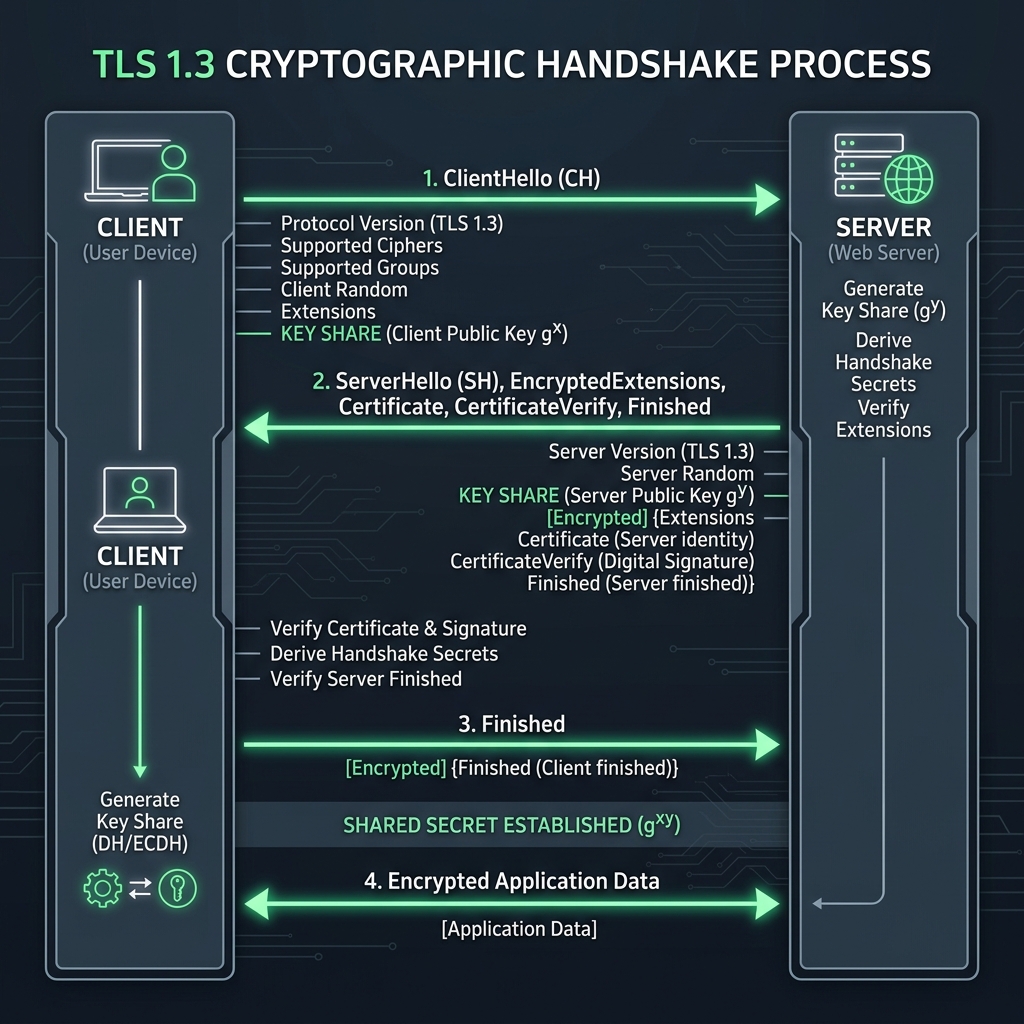
Step-by-Step TLS 1.3 Handshake:
- ClientHello (CH) & Key Share: The client sends a hello packet specifying its supported TLS versions, cipher suites, and crucially, an speculative Key Share containing its public Diffie-Hellman parameter.
- ServerHello (SH) & Server Key Share: The server selects the parameters and sends back its own public key share. Simultaneously, it sends its signed certificate, digital signature verification (CertificateVerify), and a "Finished" packet. Both endpoints now calculate the shared secret.
- Client Finished: The client verifies the server’s certificate, derives the handshake keys, and responds with a "Finished" packet.
- Encrypted Application Data: Symmetric session keys are now active, and all web traffic is encrypted.
TLS 1.2 vs. TLS 1.3: Key Differences
TLS 1.3 introduces major performance and security enhancements:
| Feature | TLS 1.2 Handshake | TLS 1.3 Handshake |
|---|---|---|
| Handshake Latency | 2 Round-Trip Times (2 RTT) | 1 Round-Trip Time (1 RTT) |
| 0-RTT Resumption | Unsupported | Supported (remembers returning users instantly) |
| Cipher Suite Options | Over 30 ciphers (many insecure) | Only 5 modern ciphers (no legacy algorithms) |
| Key Exchange | Negotiated during second round-trip | Guaranteed on the first packet (ClientHello) |
Portal Mode vs. Tunnel Mode
TLS-VPN solutions are generally deployed in one of two configurations:
- TLS Portal Mode (Web-Based): The user logs in via a standard web browser interface. Once authenticated, the user accesses an internal portal displaying bookmarked applications (like webmail, internal wikis, or file shares). No software client is installed. Access is restricted exclusively to the web-based applications configured on the gateway.
- TLS Tunnel Mode (Client-Based): The user installs a lightweight local VPN client (or browser extension). This client creates a virtual network interface card (NIC) on the client machine. All local traffic destined for the corporate network is encrypted, encapsulated inside TLS packets, and sent to the gateway. This grants full, network-level access.
Security Controls: Granularity and Host Assessment
One of the major advantages of TLS-VPN is its support for detailed access policies. Rather than granting entire network segment visibility (which poses a security risk if a remote endpoint is compromised), administrators can enforce:
- Application-Level Access Rules: Limiting a user's remote access exclusively to specific internal server resources.
- Endpoint Host Checking: Assessing the client machine before allowing the connection (e.g., verifying that the OS is updated, an antivirus is active, and no active malware is detected).
